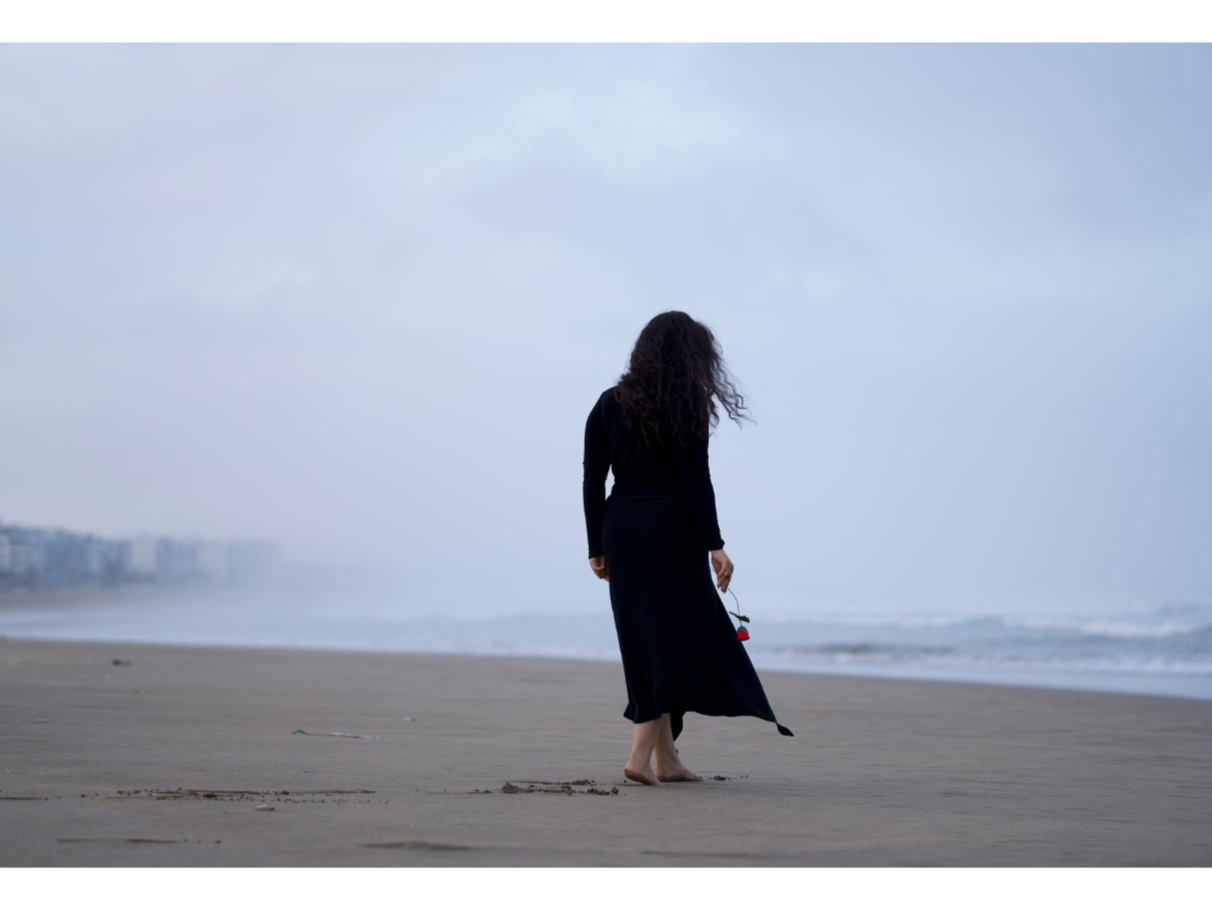
Reclaim your voice, your body, and your sacred power.
I am a psychotherapist and spiritual support who integrates evidence-based therapy with spiritual healing, honoring both the science of the nervous system and the wisdom of the soul. I never imagined I would share parts of my personal story—I've always believed the therapeutic space is for you, and my own life doesn't need to take up room in your healing. I still uphold this in our work together. Yet I've come to see there is power in being open about how I arrived at my approach, especially when that journey has taught me what I now offer others.
Early Loss and the Search for Meaning
At three years old, I experienced the traumatic loss of my father. This event fundamentally shaped my understanding of the world and set me on a path I wouldn't fully comprehend until decades later. My family turned to Catholicism for comfort and meaning. As a grieving child, I found solace in its rituals and community. But I also began to notice contradictions—teachings of compassion alongside practices of exclusion and hypocrisy, especially toward those deemed "different." I witnessed how spiritual teachings could be distorted by systems of power and control, used not to heal but to enforce rigid roles and silence questions.
I was raised in a multigenerational, third-generation immigrant family south of Boston, connected to my maternal Sicilian heritage and my paternal Irish, Scottish, and Finnish roots. Growing up within histories of immigration, assimilation, and unspoken grief, I witnessed firsthand how trauma and survival patterns pass through families—emotionally, spiritually, and epigenetically. We are children of generational trauma that has been swept under the rug for far too long, and this ancestral awareness continues to inform my work.
During those same formative years, I became aware of how girls' bodies are sexualized and objectified far earlier than we're taught to understand or process. In an environment where discomfort and emotion were rarely discussed, I learned to protect myself through humor—becoming the "funny girl" who stayed light and easygoing, avoiding vulnerability and pain. This strategy helped me feel safer but also taught me how early we learn to disconnect from our bodies and silence our truth in order to survive.
Compounded Grief and the Path to Healing
Longing for deep connection, I found it in one of my best friends—someone who felt like a sister, a soulmate who made me feel seen, safe, and free. At twenty, she died suddenly and traumatically. This loss was a complete shock to my system. It truly felt like a part of me had died. I was a child that longed for deep connection and I felt immensely grateful I had found it with her. She always made me laugh. I could take her brutal honesty and New England sarcasm while I knew that girl always had my back and I had hers. I knew what I had before she was gone and it didn’t feel real that life would take her from me so soon. The night she died, my body felt uncontrollably cold, and all I could say was, "Something is wrong." She was in another part of the country, yet I felt it deeply—like my soul knew before my mind did.
More losses followed. Friends I'd grown up with—ones who'd welcomed me into their families, intelligent friends who'd rebelled against norms and seemed to possess a higher knowing even at a young age. I lost friends to the opioid epidemic. With each loss, all my compounded grief surfaced—anger, sadness, confusion. Yet alongside it was a persistent knowing that my loved ones were still with me, just in a different form.
Clinical Training Meets Spiritual Transformation
As I continued my own healing—walking away from relationships and trauma responses that perpetuated my pain—I sought out community grounded in growth rather than survival. I found people who were no longer brushing pain under the rug or self-medicating, but embracing resilience alongside compassion and humanity. I pursued clinical training and received my masters in social work at Columbia University, initially approaching this work from a more scientific perspective. I felt connected to learn more from the research at the Center for Prolonged Grief Disorder but decided to take the more clinical route as I felt more connected to that work. For years, I relied solely on evidence-based modalities and the mechanics of the nervous system. Although, I value research being done to support our mental health, I always felt healing through grief is not something we can solely pathologize or measure. It is a deeply spiritual process that society does not honor enough. Instead of asking the question: “How do we move on?” We should be asking: “How do we honor our grief throughout our life while we become stronger and wiser in it?”
As I know healing is a nonlinear process, I felt I had built enough of a foundation or awareness to help others in their grief and trauma. I felt fulfilled in the work that I was doing but I hadn’t realized that I was about to endure an even more painful process I did not have a name for until I was left to surrender to the truth of what I was experiencing. It felt as though all of my trauma and grief was resurfacing but at times, it didn’t feel like it was just mine alone. During this period of deep emotional processing, I experienced what's known as a spontaneous Kundalini awakening—a profound spiritual and somatic transformation. This process brought intense emotional release, physical symptoms including prolonged back pain, womb pain and whole body pain, heightened intuition, ancestral pain awareness, and a deeper understanding of how trauma, grief, and healing are held within the body. Though challenging, it became a sacred remembering that reshaped both my personal life and professional practice. It revealed to me that spirituality wasn't something I was discovering—it was something I was remembering, something that had always been part of my life without my full awareness. I was not just seeing myself from a new lens, I was reclaiming my primal sexual, creative, healing and maternal energy — something systems have taken for granted, abused and siphoned for centuries.
Understanding Collective Wounds
Through this journey, I came to understand that many of our wounds are not solely individual but shaped by generations of silence, imbalance, and systemic harm. I began to recognize deeper collective patterns—the severing of what ancient traditions understood as masculine and feminine energies that once existed in harmony within the soul. These energies aren't about gender but about the qualities we all carry: strength and tenderness, logic and intuition, action and receptivity. Systems of dominance have fractured this balance, elevating control over compassion, competition over connection.
I explored my own lineage through visions, deep listening and intuition and became aware of the immense pain carried by the women in my family—women who loved fiercely, gave endlessly, and often sacrificed themselves within systems that did not protect or honor them. I witnessed how loyalty, empathy, and emotional labor were repeatedly met with loss, betrayal, and silence. My mother's grief after losing the love of her life - a man who loved and honored her soul - became a living reflection of this generational wound. Her heartbreak moved through me during deep purges of pain in my spiritual awakening. I also received a deeper understanding of my own souls purpose and why my soul to waking up now.
These same systems have led to cycles where we betray ourselves and each other—women competing with women, men competing with men, people centering external validation rather than inner truth. All of this stems from centuries of distortion: rigid, gendered, black-and-white thinking embedded in our cultures that has caused us to forget our soul's essence—the balance within us all.
I've come to understand my work as part of an ancient lineage of healing—working with energy, intuition, ancestral wisdom, and the body's innate knowing. These practices have been honored in Indigenous traditions for millennia, even as they've been suppressed, labeled dangerous, or appropriated by dominant cultures. I honor this inheritance while respecting that it doesn't belong to me alone.
My Approach and Who I Serve
Today, my work integrates scientifically grounded modalities with somatic awareness, intuitive insight, and soul-centered healing. I support you in reconnecting with your own inner wisdom and resilience. Together, we gently explore protective patterns of the ego, release stored trauma, challenge internalized beliefs that once kept you small, and restore balance between mind, body, and spirit.
My work is especially supportive for those navigating grief and complex loss, trauma and its somatic impacts, or spiritual awakening and questioning. I work with people engaged in ancestral and intergenerational healing, those experiencing identity shifts shaped by systemic or relational harm, and anyone seeking to reconnect with their body or inner knowing.
I hope to guide you in coming home to yourself—whole, empowered, and aligned with your truth. I work best with clients who are ready to look honestly at their pain, willing to explore both the wounds they carry and the ways they may have protected themselves through disconnection. This work asks you to be willing to look into the mirror, to notice when you're out of balance, when your ego speaks louder than your soul, when your wounded inner child holds you back from growth.
Ultimately, this is an invitation to remember: the depth of your pain is a reflection of the depth of your love.